

 English
 中文简体
中文简体When a food manufacturer asks whether broccoli powder is worth adding to a product line, the short answer is yes — provided the powder is made from quality raw material and processed at temperatures that preserve its enzymatic potential. A concentrated serving of broccoli powder can bring nutrients, color, and a mild cruciferous flavor to dry mixes, beverages, nutritional bars, and supplements.
Bottom line: Broccoli powder offers a practical way to add vegetable-based phytonutrients, fiber, and natural green color to food products without refrigeration or short shelf life. The real value depends on choosing a supplier that controls raw-material quality and processing temperature.
Content
- 1 What Makes Broccoli Powder Nutritionally Distinct
- 2 The Sulforaphane Efficiency Factor: Why Processing Temperature Matters
- 3 Broccoli Powder vs Fresh Broccoli: A Practical Purchasing View
- 4 Where Broccoli Powder Adds the Most Value in Food Manufacturing
- 5 How to Source Broccoli Powder That Actually Delivers Benefits
- 6 Storage, Labeling and Compliance Considerations
What Makes Broccoli Powder Nutritionally Distinct
Broccoli is naturally rich in vitamins K and C, folate, potassium, and fiber. When water is removed, those compounds become more concentrated by weight. A 10 g serving of powder (roughly one tablespoon) can provide a meaningful fraction of the same nutritional load as a 100 g serving of fresh florets, but in a form that is stable and easy to dose.
The more interesting value lies in bioactive plant compounds. Broccoli contains glucosinolates, particularly glucoraphanin, which can be converted by the enzyme myrosinase into sulforaphane. Sulforaphane is the molecule linked to most of the health research around broccoli: antioxidant response, detoxification support, and reduced inflammation.
Vitamin K
Support for bone metabolism and normal blood coagulation; 10 g of powder can supply a significant share of the daily need.
Dietary fiber
Powder retains insoluble and soluble fiber, making it a practical ingredient for gut-health or satiety claims.
Vitamin C and antioxidants
Offers antioxidant capacity and helps preserve natural color; actual levels depend on drying temperature and storage.
Glucosinolates
Precursors to sulforaphane; present when processing avoids prolonged high heat and rapid oxidation.
The Sulforaphane Efficiency Factor: Why Processing Temperature Matters
Sulforaphane is not present in intact broccoli in large amounts. It forms when glucoraphanin and myrosinase meet after the plant cells are cut, chewed, or ground. That same reaction is easy to destroy with heat. Boiling broccoli, for example, can deactivate myrosinase at around 60–70 °C, reducing sulforaphane formation unless the enzyme is reintroduced separately.
For powdered broccoli, the two most important processing decisions are the drying temperature and the milling temperature. Low-temperature air drying (typically below 50 °C) and gentle milling protect enzyme activity and preserve the natural green color. High-temperature drying may kill microorganisms and speed production, but it sacrifices the very compound that makes broccoli powder a functional ingredient.
Understanding these process trade-offs can make a real difference in supplier selection. A practical explanation of how dehydration methods influence nutrient retention is covered in how vegetable powders retain nutrients during processing.
Relative sulforaphane-formation potential after processing (indicative, not a precise lab assay):
Broccoli Powder vs Fresh Broccoli: A Practical Purchasing View
Food buyers often compare fresh and powdered forms based on yield and cost. The table below reflects typical considerations for an industrial kitchen or processing plant.
Attribute
Fresh broccoli (as purchased)
Broccoli powder (dry)
Nutrient density
High, but water-heavy
Very high per gram
Shelf life
7–14 days refrigerated
18–24 months sealed
Preparation
Washing, trimming, cutting
Free-flowing, ready to blend
Logistics
Cold chain required
Ambient, compact storage
Microbial risk
Higher, especially after cutting
Lower if water activity ≤ 0.6
Best application
Steamed dishes, salads
Dry mixes, drinks, supplements
Indicative comparison for food-processing decisions. Exact values depend on cultivar, processing method, and packaging.
Where Broccoli Powder Adds the Most Value in Food Manufacturing
In our experience supplying dehydrated vegetable powders, broccoli powder is rarely used alone. It performs best in applications that need a clean-label green vegetable ingredient with a mild flavor that can be masked or complemented. Estimated market-use distribution among our client product categories is roughly as follows.
Functional foods & beverages (35%)
Sports nutrition (25%)
Soups & sauces (15%)
Snacks & bakery (15%)
Pet food & other (10%)
Functional beverages and powders are the fastest-growing area because the color and nutrition can be added without altering moisture content. Sports nutrition brands use broccoli powder to support an antioxidant claim in post-workout recovery blends. Soups, sauces, and seasonings benefit from its fiber and umami-adjacent green notes.
How to Source Broccoli Powder That Actually Delivers Benefits
Because the benefits of broccoli powder depend on enzyme activity and nutrient retention, a commodity purchase based only on price can be a costly mistake. Use this short checklist when evaluating suppliers.
- Verify raw material identity. Ask for the broccoli cultivar and harvest season; older or overheated raw material produces lower sulforaphane precursor levels.
- Ask about drying temperature and milling. A low-temperature air-drying chain is a good sign; a purely high-heat process may reduce myrosinase activity.
- Check particle size and bulk density. Particle size affects dispersion and color payoff. Typical food-grade broccoli powder ranges from 40 to 120 mesh.
- Review micro and metal specs. Standard commercial specs include total plate count, yeast and mold, coliforms, and lead/arsenic limits set by the destination country.
- Request a pilot sample. Test color in your dough or drink matrix, and check how the powder behaves under your mixing and heating steps.
When you are ready to compare suppliers, a useful starting point is a product like our dehydrated broccoli powder, which is produced with controlled drying and milled to a consistent particle size for food and beverage applications.
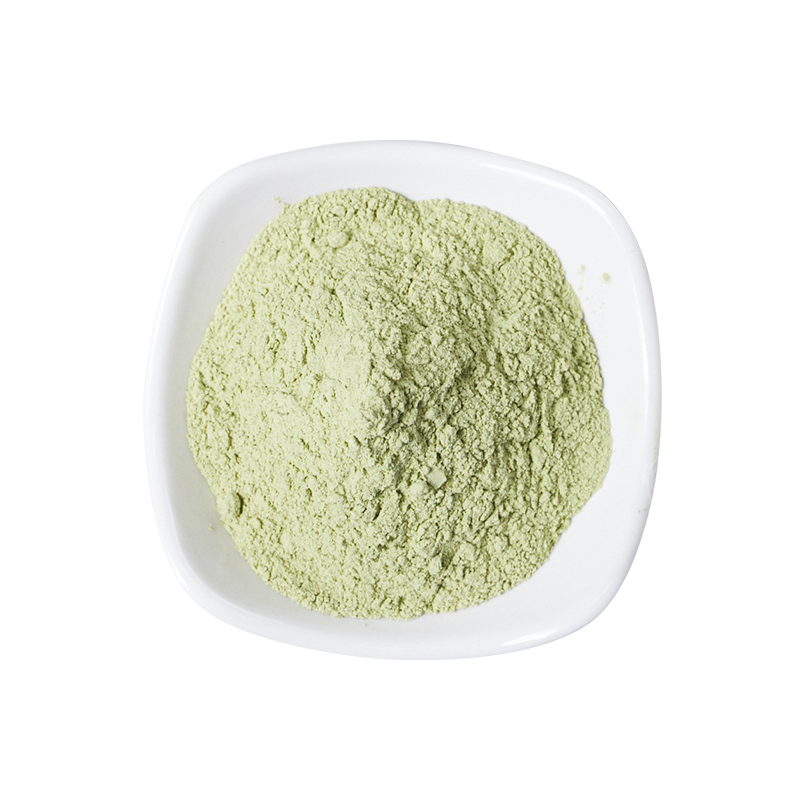 Dehydrated broccoli powders Manufacturers, Dried broccoli powders Suppliers, FacAs China Wholesale Dried broccoli powders Manufacturers and Bulk Dehydrated broccoli powders Suppliers and Dehydrated broccoli powder Fac...View Product →
Storage, Labeling and Compliance Considerations
Even good-quality broccoli powder loses quality if stored incorrectly. Moisture is the main enemy: low water activity (≤0.6) is essential to prevent microbial growth and browning. In bulk packaging, keep the warehouse below 25 °C and relative humidity below 60%, and avoid direct sunlight to preserve chlorophyll color.
From a regulatory perspective, broccoli powder is generally recognized as safe in most markets as a vegetable-based ingredient, but labeling rules differ. In the EU and US, declare it as "broccoli powder" in the ingredient list, and verify that any claims about "source of vitamin C" or "source of fiber" match the actual analytical values. If you market an organic version, the certification must be traceable from field to finished powder.
- Monitor moisture content on each lot; a good target is ≤6% for long-term stability.
- Request certificates of analysis for heavy metals and pesticide residues, especially if used in baby food or supplements.
- Consider a shelf-life study for your final product, not just the powder, because the color change in your formulation may differ from the powder itself.
In short, broccoli powder is not a magic bullet; it is a well-researched, versatile vegetable ingredient that can add genuine nutritional and functional value when sourced deliberately and handled properly.


 Xinqian Village (Dehydrated Fruit and Vegetable Industrial Park), Duotian Street, Xinghua City, Taizhou City, Jiangsu Province, China
 +86-13852647168
