

 English
 中文简体
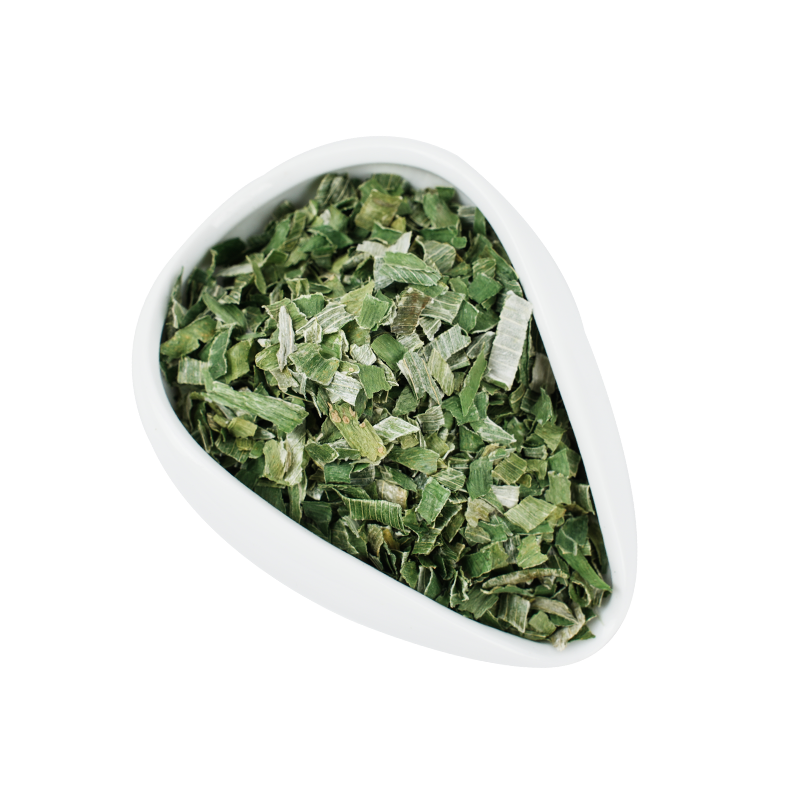
中文简体Ingredient lists are under more scrutiny than ever. Across soup blends, seasoning mixes, ready-to-eat meals, and snack coatings, food manufacturers are being asked — by retailers, by buyers, and increasingly by regulation — to cut synthetic additives from their formulations. For dried herbs and vegetables, that pressure lands directly on one question: how do you keep a product shelf-stable for 12 to 24 months without reaching for a preservative?
With dehydrated chives, the answer has always been built into the process itself. The challenge now is finding suppliers who understand that distinction — and can document it.
Content
Why Food Manufacturers Are Rethinking Preservatives in Dried Herbs
The clean label movement has moved well past trend status. Nearly 3 in 4 consumers globally now report reconsidering a purchase after reading the ingredient list, and demand for products carrying "no preservatives" claims continues to outpace the broader food market. For food manufacturers, this creates direct pressure on every ingredient that goes into a formulation — including the dried herbs and vegetable inclusions that season soups, sauces, and snack products.
The challenge with dried herbs has historically been that preservatives — sulfites in particular — were used both to extend shelf life and to maintain color. A dried chive treated with sulfites stays visibly green longer, which made the practice commercially attractive even as consumer tolerance for additive-heavy labels declined.
That trade-off is no longer acceptable to a growing share of buyers. Major retail buyers now require clean label compliance as a condition of listing. Food service procurement teams audit ingredient declarations. Private label brands building around natural positioning cannot afford a preservative disclosure buried in the middle of an otherwise short ingredient list. The demand for dehydrated chives with no preservatives is not a niche request — it has become a baseline specification in many procurement conversations.
How Dehydration Naturally Eliminates the Need for Preservatives
Understanding why well-processed dehydrated chives require no preservatives starts with the microbiology of spoilage. Bacteria, mold, and yeast all require available water to grow. Remove moisture below a critical threshold — typically a water activity level below 0.6 — and microbial activity effectively stops. The product becomes shelf-stable not because a chemical inhibits growth, but because the environment for growth no longer exists.
This is what proper dehydration achieves. Whether through controlled hot-air drying or freeze-drying, the goal is the same: reduce moisture content to a level where no biological preservative mechanism is needed. A dehydrated chive product that reaches the correct moisture specification — typically 5% or below — will maintain its safety and quality for 12 to 24 months under appropriate storage conditions without any added preservatives, sulfites, or antimicrobial agents.
The practical implication for food manufacturers is significant. Preservative-free dehydrated chives are not a compromise formulation — they are the correct outcome of a process done well. When a supplier adds preservatives to dried herbs, it often signals one of two things: inconsistent moisture reduction during processing, or a shortcut to compensate for quality variability across batches. Neither is acceptable in a supply chain built around clean label compliance.
Color retention — the usual justification for sulfite use — can be achieved through careful temperature management during drying. Chives dried at controlled, lower temperatures preserve their characteristic green color without chemical treatment, provided the raw material is processed promptly after harvest and the drying parameters are properly calibrated.
Nutritional Integrity: What Dehydrated Chives Retain
A concern sometimes raised about dehydrated vegetables is whether the processing strips nutritional value along with moisture. For dehydrated chives specifically, the picture is more favorable than the concern suggests.
Dietary fiber and essential minerals are not water-soluble and survive the dehydration process largely intact. Dehydrated chives remain a meaningful source of fiber, calcium, and iron — nutrients that are relevant not just to finished food products marketed on nutrition grounds, but also to pet food and health supplement formulations where mineral content is a specification requirement.
Some water-soluble vitamins — vitamin C in particular — do see reduction during drying, with the extent depending on temperature and processing time. Freeze-drying preserves more of these heat-sensitive compounds than hot-air drying, which is why it commands a price premium in applications where vitamin retention is a primary specification. For most culinary applications, however, the flavor compounds, color, and fiber profile of well-dried chives are the primary performance criteria — and these hold up well across both drying methods when process controls are maintained.
Crucially, none of the nutritional retention that makes dehydrated chives valuable to food formulators requires preservative use. The fiber is there because the cell structure survives dehydration. The minerals are there because they were in the raw material. The clean label claim and the nutritional profile are fully compatible — and that combination is precisely what the market is asking for. Explore the full range of dehydrated vegetable products available for food manufacturing applications.
Application Across Food Categories
Dehydrated chives with no preservatives serve a broad range of end-use categories, and the clean label positioning adds commercial value across all of them.
In soups and sauces, dried chives function as a flavor inclusion and a visual garnish element. The absence of preservatives is directly visible on the finished product's ingredient declaration — a short, recognizable list that supports "natural" and "clean" positioning at retail. In seasoning blends and spice mixes, the same logic applies: a blend built entirely from preservative-free dehydrated vegetables and herbs carries a label that needs no explanation.
Ready-to-eat and convenience meal formats have seen particularly strong growth in clean label demand, driven by the consumer expectation that convenience and ingredient transparency should not be mutually exclusive. Dehydrated chives rehydrate reliably during cooking, delivering both flavor and visual green color to the finished meal without any processing aid or additive intervention.
Beyond conventional food manufacturing, dehydrated chives without preservatives are well positioned for pet food formulations — where ingredient transparency is becoming as important to pet owners as it is to human food consumers — and for health supplement products where additive-free sourcing is a baseline requirement. For applications requiring a finer particle size or faster rehydration, dehydrated vegetable powder options offer equivalent clean label credentials in a format suited to seasoning coatings, instant products, and encapsulated supplements.
For food brands building formulations around preservative-free specifications, sourcing consistency matters as much as the initial product quality. Batch-to-batch variation in moisture content, color, and particle size creates compliance risk in clean label claims and quality control challenges in production. Custom manufacturing solutions for food brands that include specification-aligned processing, documentation support, and scalable supply are the practical foundation that clean label sourcing requires — not just a product that passes a single test, but a supply relationship that holds the standard across every order.
 Previous

 Xinqian Village (Dehydrated Fruit and Vegetable Industrial Park), Duotian Street, Xinghua City, Taizhou City, Jiangsu Province, China
 +86-13852647168
